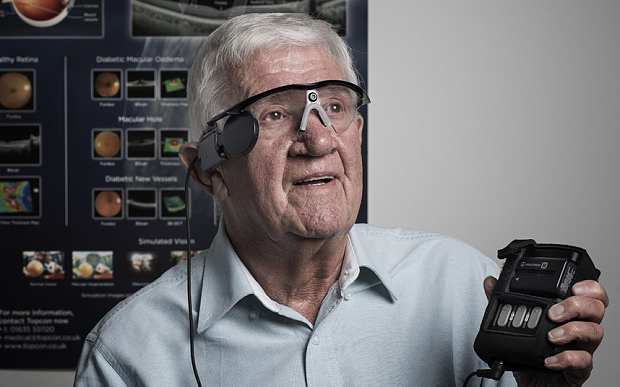
Bionic Eyes have made its first major breakthrough with its first human trial declared a success in the United Kingdom.
Click on this link to see a video on the BBC about the trial. Click here to read more about how the bionic eye has helped Ray Flynn, beneficiary of the first human trial.
The United States government has approved a bionic eye for the first time to help blind people. It is meant for those with retinitis pigmentosa, but could also be used to treat those with macular degeneration in future.
Electrical stimulation is sent to the retina to induce vision. Some of the early patients testing the device said they could distinguish boundaries between objects and differentiate light from dark.
Some could read large letters, while for others, being able to match sock colors and detect street curbs were more important for helping them to live more independently. There are other projects to come up with a bionic eye but this is the first one which has been officially approved by the US Food and Drug Administration. Read here for a 2010 report on our blog on another bionic eye project.
Click here and here to read more about this device, which is called Argus II.
Bionic spectacles could soon be on sale to help hundreds of thousands of blind people ‘see’. Oxford University researchers are developing ‘smart spectacles’ that use tiny cameras and a pocket computer to alert wearers to objects and people ahead.
They will make it easier for the blind to navigate shopping centres and busy train stations, and could even allow them to ‘read’ bus numbers and the computerised displays on cash machines. The lightweight, inexpensive glasses, which could be ready for general sale as early as 2014 if tests are successful, would be suitable for most of the 300,000 Britons who are registered blind.
Elderly people with age-related macular degeneration are likely to be the biggest beneficiaries. Previous attempts to create such a device have resulted in large dark glasses with clunky cameras and bulky computers. But advances in technology mean it should be possible to create bionic spectacles that look almost indistinguishable from standard glasses.
Importantly, a price tag of less than £1,000 should make them affordable, the Royal Society’s Summer Science Exhibition heard. Dr Stephen Hicks, a clinical neuroscience researcher who is being funded by the Department of Health, said: ‘It is satisfying to think that we will be able to produce this at a cost that is going make it available to the people who will benefit the most.’
Dr Hicks has completed the basic research and is now working on prototype spectacles. He envisages transparent glasses with lenses studded with small light-emitting diodes and cameras the size of a pinhead at the outside top corners of the frame. The cameras will take in the information the eyes should see and send it down a cable to a mobile phone-sized computer in the wearer’s pocket. The computer will process the information and simplify it into a pattern of dots. The LEDs in the lenses then light up in that pattern, giving the wearer vital information about what lies ahead.
A flickering light could mean there is a person ahead, while a solid block might signify an object such as a flight of stairs. While such information may seem unimpressive to the sighted, it could allow those who have lost much of their vision to regain sufficient independence to go shopping alone or take public transport.
Adding in an earpiece could allow more complex information to be transmitted. For instance, the cameras could capture bus numbers or information on railway departure boards to be analysed by the computer. Once processed, the information would be passed on to the wearer via a voice in their ear. In time, the same principle could be used to help blind people to ‘see’ the screens on cash machines outside banks or ticket dispensers at train stations. The bionic spectacles rely on the wearer being able to perceive light, so will not be suitable for those who are totally blind. But most of those registered blind, including many sufferers of age-related macular degeneration, still have some vision.
Dr Hicks plans to do small-scale laboratory tests on the blind this year, before enrolling 120 people in a two-year trial that will explore the use of the spectacles in shopping centres and at home.
Macular degeneration patients can look forward to a new eye implant which is already making waves in Europe. Three patients in Germany were able to see shapes and objects within days of the implant being installed.
One was even able to identify and find objects placed on a table in front of him, as well as walking around a room independently and approaching people, reading a clock face and differentiating seven shades of grey, reports journal Proceedings of the Royal Society B.
The implant sits beneath the retina and works as a direct replacement for light receptors lost to the condition. Because it is internal, it uses the eye's natural image processing capabilities beyond the light detection stage to produce a visual perception in the patient that is stable and follows their eye movements. Previous implants sit outside the retina and require the user to were an external camera and processor unit.
If successful, the implant can be used for macular degeneration sufferers. The device is being hailed as an "unprecedented advance" in visual aids.
Professor Eberhart Zrenner, chairman of the University of Tuebingen Eye Hospital, told Daily Telegraph: "The results of this pilot study provide strong evidence that the visual functions of patients blinded by a hereditary retinal dystrophy can, in principle, be restored to a degree sufficient for use in daily life.
"The present study presents proof-of-concept that such devices can restore useful vision in blind human subjects, even though the ultimate goal of broad clinical application will take time to develop."
David Head, chief executive of the British Retinitis Pigmentosa Society, said that it was exciting news but that it was early days. This is very significant process but it is a long way off being a bionic eye."
Professor Robert MacLaren, of Oxford University, who will carry out trials in Britain next year, said: "This is quite a breakthrough. It is akin to someone paralysed with a spinal injury standing up and walking."
The Macular Degeneration Society is a non-profit organisation set up in 2007 to support macular degeneration patients and build awareness of this eye disease in Singapore. This blog shares news, developments, rumours and yes, even gossip, on this degenerative eye condition which leads to central vision loss.